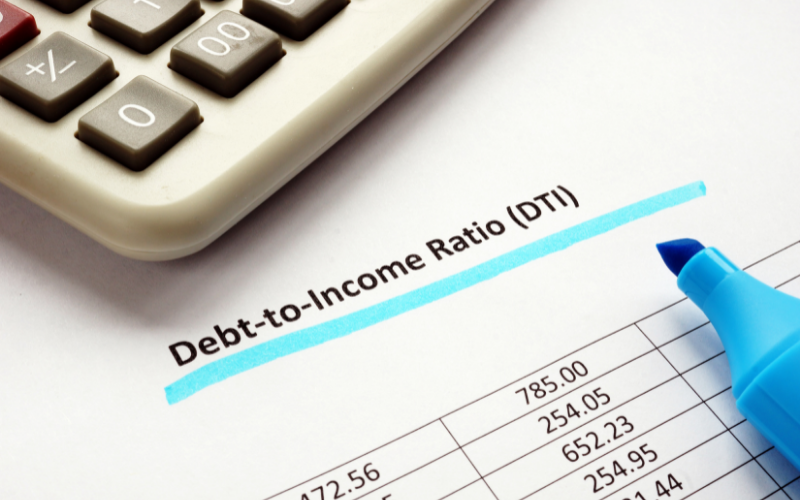
 If you are looking for a home, you might need to finance it using a lender, such as a bank or a credit union. There are a number of factors that will influence whether your mortgage application is approved. Then, these same factors will play a role in the terms the lender might offer you. One of the most important factors is called the debt to income ratio, or DTI. It is important to understand how this will impact your mortgage application.
What Is A Debt To Income Ratio?
Your DTI is important to the lender because this allows the lender to figure out the likelihood of you paying your mortgage on time. The less debt you have, the more financial stability you have to pay a potential mortgage.
To calculate your debt to income ratio, you need to calculate all the bills you have for the upcoming month. For example, if you have rent and a car payment, you add these numbers together. Then, you divide this number by your gross monthly income. If your rent is $900 and your car payment is $200, your total debt is $1100. Then, if you earn $3300, divide $1100 by $3300. This is about 33 percent.
Student Loan Debt Is A Driving Factor
With many members of the younger generation getting ready to purchase a house, it is important to understand the impact of student loan payments. Because a lot of potential home borrowers have student loans to pay back, their debt-to-income ratios will be significantly higher. This could make it harder for younger borrowers to get qualified for a mortgage, particularly one with favorable terms.
How To Improve Your Mortgage Application
Before you apply for a home loan, you should try to improve your debt to income ratio by paying down your existing bills. For example, if you have credit card debt, this will be included in your debt to income ratio. Try to pay this off before you apply for a mortgage. You should try to pay down your student loans as much as possible before applying for a mortgage as well. The less debt you carry, the more likely your mortgage application will be approved.
 Last week’s economic news included remarks given by Federal Reserve Board Governor Lael Brainard and the release of the minutes of the most recent meeting of the Fed’s Federal Open Market Committee. Weekly readings on mortgage rates and jobless claims were also released.
 Purchasing a house is expensive. Not everyone has the money to put down 20 percent. One of the ways to make it easier to afford a house is to live in a home with multiple generations. Some people decide to move back in with their parents because they might have a difficult time affording a mortgage and student loans. Some parents move in with their children because they have health-related issues that need to be addressed. Now, multi-generational homes are becoming more common.
 If you want to save money on your mortgage, now might be a great time to refinance. When you refinance your home loan, you replace the existing mortgage with a different one. You can refinance your home to withdraw cash, shorten the term of the loan, or reduce your interest rate. Not everyone can refinance the house, so take a look at a few key rules you need to follow to qualify for a refinance.
 There was a time when a higher percentage of people were married before they committed to buying a home together, but it’s a lot more common to co-habit and invest in a home together. If you’re considering the commitment of a mortgage without being married, here are some things to be aware of before you start searching the market.
 The concept of going green is often seen as an expensive process, and this can stop many people from taking the small steps needed to make their home more environmentally friendly. If you want to green-ify without any of the high costs, here are some simple things you can do that will easily improve the energy efficiency of your home.
 Last week’s financial and economic reporting included readings from S&P Case-Shiller Home Price Indices, the Federal Housing Finance Agency and the federal government reported on construction spending. Reports on public and private-sector jobs growth and the national unemployment rate were also published along with weekly readings on mortgage rates and jobless claims.
 When you buy a home, you probably have a budget you will try to stick to. Many people choose a 30-year fixed mortgage, and by the time you pay off the home loan, you should own your home outright. At the same time, you might be thinking about paying off your mortgage more quickly to save money on interest. Even making one extra mortgage payment per year can provide a number of significant benefits.
 Even though a lot of people have two incomes they can use to purchase a house (theirs and their partner’s), this is not necessarily required. There are lots of people who want to take advantage of current interest rates to purchase a house, and some people are trying to do it on their own. Even though it can be a challenge to buy a house with only one income, it is certainly not impossible. There are several tips that can make it easier for everyone to afford a house with just a single income.